Academic Project Page

EMFusion: Uncertainty-Aware Conditional Diffusion for Frequency-Selective EMF Forecasting

Zijiang Yan*, Yixiang Huang*, Jianhua Pei, Hina Tabassum, Luca Chiaraviglio

EMFusion is an uncertainty-aware conditional diffusion framework for frequency-selective EMF forecasting in wireless networks. This page presents the manuscript, core method figures, related diffusion-based prior work, and supporting local research assets bundled with the site.

Overview

What this project page presents

Project framing

This repository is centered on EMFusion, a diffusion-based framework for probabilistic forecasting of frequency-selective EMF exposure in wireless networks. The included manuscript provides the technical narrative, methodology, and evaluation figures that define the project.

The presentation below centers the two key method figures from the manuscript: the residual U-Net architecture and the conditional cross-attention forecasting pipeline.

Abstract-style summary from the manuscript

The included paper introduces EMFusion, a conditional multivariate diffusion framework for frequency-selective EMF forecasting. It integrates contextual signals such as time, season, and holidays, uses cross-attention in a residual U-Net backbone, and produces probabilistic forecasts with explicit uncertainty estimates.

According to the manuscript abstract, the reported model improves on the strongest baseline by 23.85% in CRPS and 13.93% in normalized RMSE while reducing prediction interval error by 22.47%.
Highlights

Main elements surfaced on this page

Residual U-Net backbone

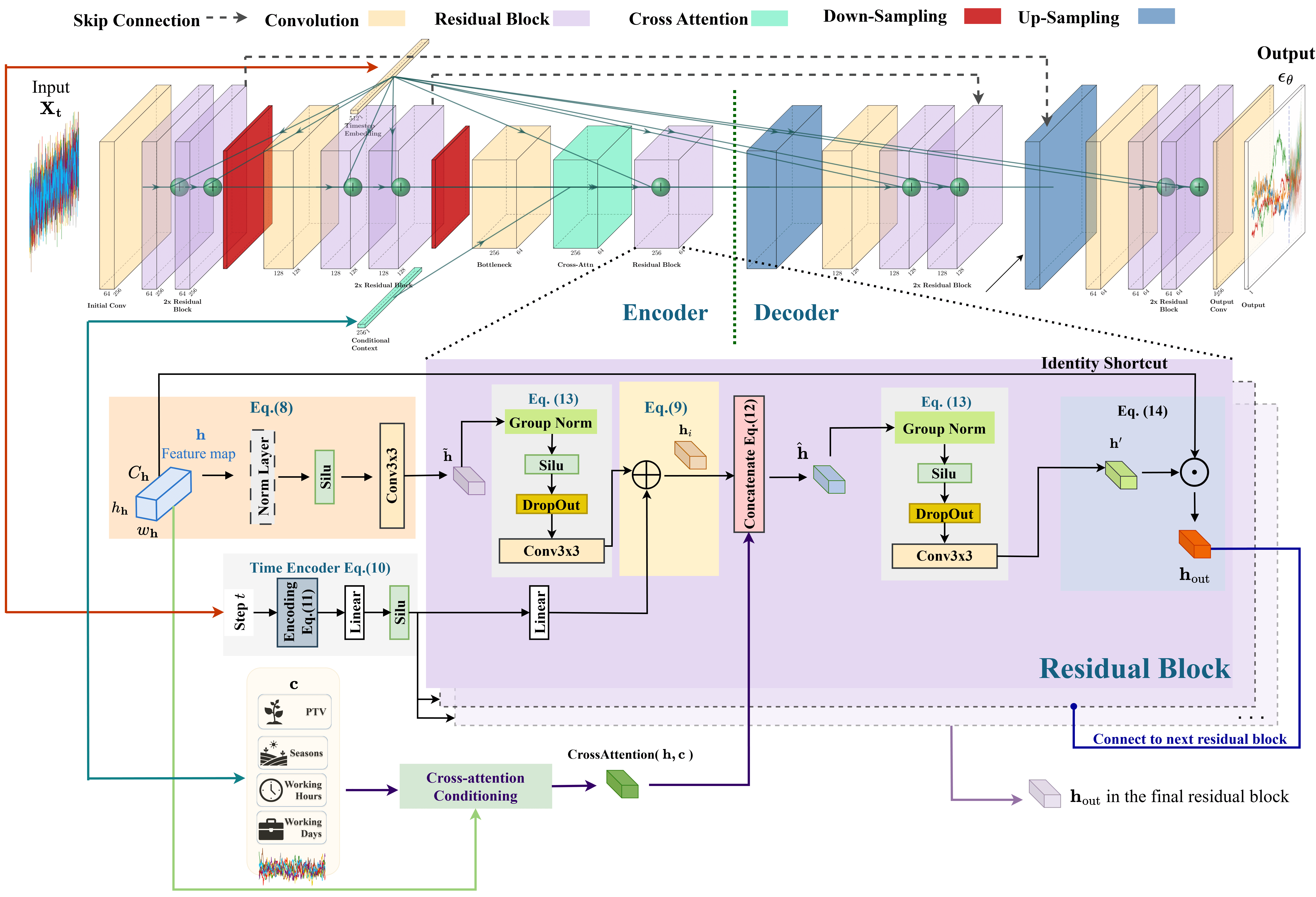
EMFusion predicts diffusion noise with a symmetric encoder-decoder network composed of residual blocks, downsampling, and upsampling stages.

Cross-attention conditioning

External conditions are injected dynamically through cross-attention instead of simple concatenation, letting the model reweight context across temporal scales.

Probabilistic forecasting

EMFusion treats forecasting as iterative denoising and generates multiple stochastic futures for interval construction and uncertainty-aware decision support.

Architecture

U-Net architecture and cross-attention pipeline

The manuscript defines EMFusion through three connected ideas: diffusion as iterative refinement, cross-attention as dynamic weighting of contextual signals, and imputation-style forecasting as structured temporal inpainting. The two figures below are the center of that story.

EMFusion residual U-Net architecture
Residual U-Net backbone. The noisy input is processed through a symmetric encoder-decoder path. Timestep embeddings are injected into residual blocks, and the intermediate feature maps are refined before reconstruction.

Why the U-Net backbone matters

The manuscript uses a U-Net backbone for the noise-prediction network εθ. Encoder and decoder paths are symmetric, and each residual block applies normalization, SiLU activation, convolution, timestep conditioning, and a residual shortcut.

This design lets EMFusion operate directly on the multivariate time-frequency tensor rather than collapsing the problem into isolated point predictions. In the manuscript's framing, the model learns to reverse Gaussian corruption step by step and recover a structured future trajectory.

Residual refinement: each block progressively denoises features while preserving a shortcut path.

Timestep awareness: sinusoidal timestep embeddings make every block explicitly aware of the current diffusion stage.

Multiscale context: the encoder-decoder layout preserves both local detail and broader temporal structure.

How cross-attention conditions the forecast

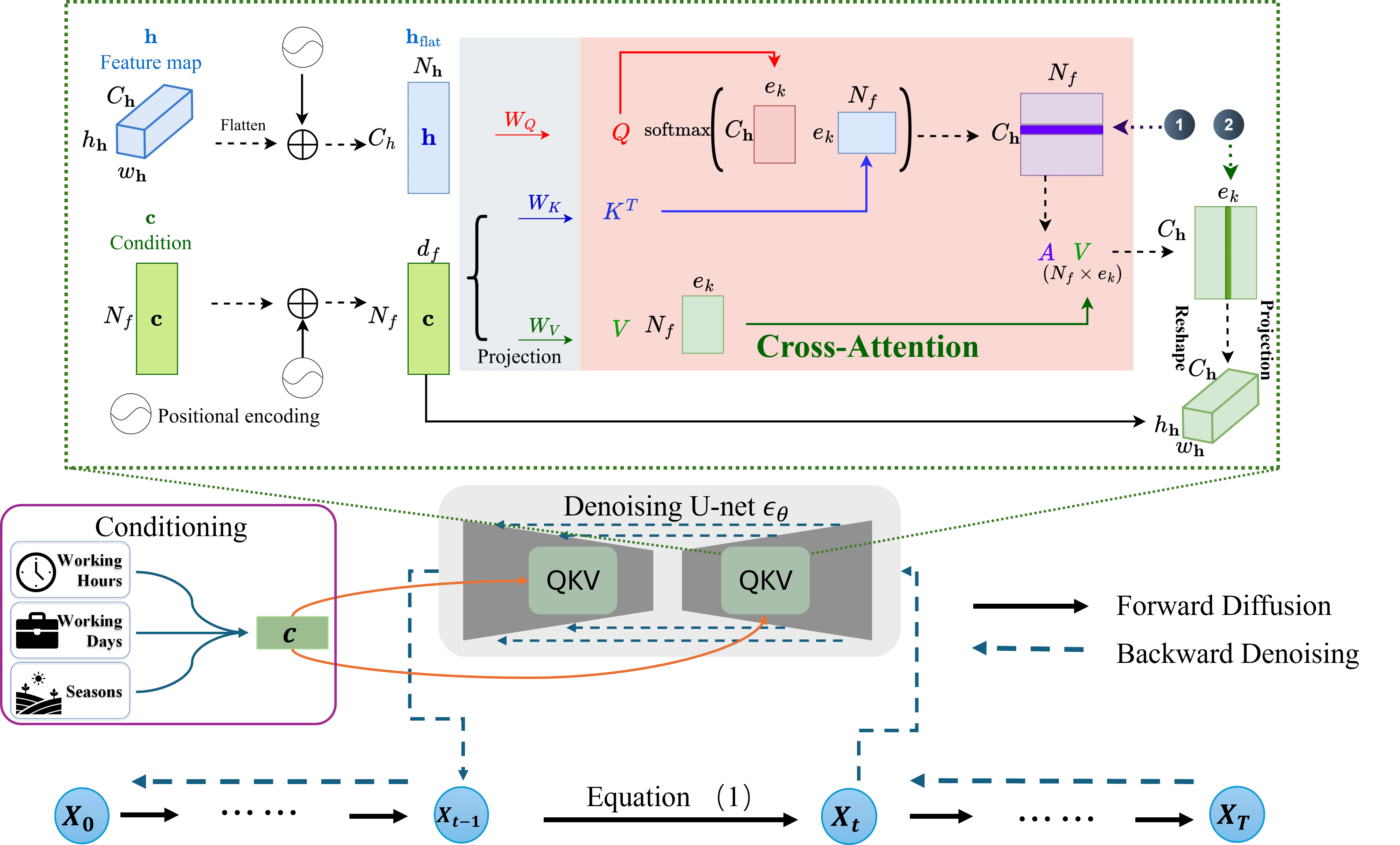
Instead of concatenating side information once at the input, EMFusion uses cross-attention modules at multiple encoder and decoder layers. The feature map produces queries, while the condition tensor provides keys and values.

In the manuscript, positional encoding is added to both the flattened feature map and the condition sequence before attention is computed. This preserves order information while letting the model learn data-dependent correlations between EMF dynamics and context such as working hours, seasons, or holidays.

Queries: projected from the feature map currently being denoised.

Keys and values: projected from external conditions and reused to weight relevant context.

Residual fusion: the attention output is reshaped and added back to the feature map so conditioning modulates, rather than replaces, the learned representation.

EMFusion cross-attention forecasting pipeline
Conditional multivariate forecasting pipeline. EMFusion forms queries from the latent feature map and keys and values from the context tensor, then injects the resulting attention output back into the denoising network.

Diffusion as iterative refinement

Future EMF trajectories are generated by repeatedly denoising a noisy sequence, which allows EMFusion to model a full conditional distribution instead of a single deterministic forecast.

Inpainting-style inference

The manuscript treats forecasting as structural inpainting, so missing historical values and future values can be handled within one masked diffusion process.

Uncertainty-aware output

Multiple generated trajectories can be turned into empirical predictive intervals, supporting probabilistic EMF monitoring and planning rather than point-only estimation.

Resources

Included manuscript materials

Paper

EMFusion: Conditional Diffusion Framework for Trustworthy Frequency Selective EMF Forecasting in Wireless Networks

Zijiang Yan, Yixiang Huang, Jianhua Pei, Hina Tabassum, and Luca Chiaraviglio

Related prior work

Semantic-Aware Adaptive Video Streaming Using Latent Diffusion Models for Wireless Networks

Zijiang Yan, Jianhua Pei, Hongda Wu, Hina Tabassum, and Ping Wang

Method cues from the manuscript

  • Conditional diffusion for multivariate forecasting
  • Cross-attention integration of external context
  • Imputation-based inference for temporally coherent prediction
  • Frequency-selective EMF analysis across operators and technologies

Discussion anchors

  • Residual blocks with timestep embedding
  • QKV conditioning with positional encoding
  • Multivariate versus univariate forecasting
  • Probabilistic intervals from sampled futures